Aundha Nagnath
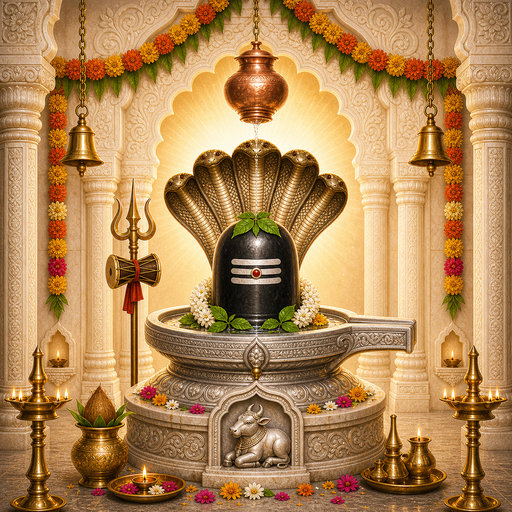
Aundha Nagnath is an ancient Shiv temple in the village of Aundha in Hingoli district — the Nagnath (Nagesh) Jyotirlinga, regarded as one of the twelve Jyotirlingas, and in Aundha’s own tradition as the eighth. Its most distinctive feature is an underground sanctum (bhuyari gabhara) — the main Shivling sits in a chamber below ground level, reached by a narrow flight of stairs. The famous local legend is that when priests obstructed the Varkari sant Namdev, the whole temple turned around so its entrance faced him. It is known for its Hemadpanti + Maratha architecture, its status as an ASI-protected national monument, and the night-time rathotsav (chariot festival) on Mahashivratri that draws lakhs of devotees.
This year's dates (2026)
- Mahashivratri — Aundha Nagnath’s biggest day; a night rathotsav, lakhs of devotees15 Feb
- Vijayadashami / Dasara — devotees also come here on Shivratri and Vijayadashami20 Oct
- Tripurari Pournima — a general Shaiva festival24 Nov
Deity & significance
Aundha Nagnath is regarded as one of the twelve Jyotirlingas — a Jyotirlinga being a swayambhu (self-manifested) form of Shiv’s light. It is one of the five Jyotirlingas that devotees in Maharashtra revere and visit most; the others are Trimbakeshwar, Bhimashankar, Grishneshwar and Parli Vaijnath. All five of Maharashtra’s Jyotirlingas are introduced together on the Jyotirlinga hub page.
The number and the “Nagesh” dispute (Aundha’s own identity, contested elsewhere).
In Aundha’s local tradition this is regarded as the eighth Jyotirlinga, and that is Aundha’s own identity. However, the Dvadasha-Jyotirlinga stotra line “Setubandhe tu Ramesham, Nagesham Darukavane” doesn’t specify exactly which temple its “Nagesh” refers to — three sites claim that identity: Nageshwar near Dwarka (Gujarat, currently the widely accepted one), Jageshwar (Almora, Uttarakhand), and Aundha Nagnath. The mainstream scholarly view places “Darukavana” near Dwarka; Aundha’s claim rests on a southern-location / ancient-Aundh reading. Aundha’s identity as the Nagesh Jyotirlinga is thus a matter of local tradition, not settled fact.
(Note: in the shastrokta Dvadasha-Jyotirlinga list, the count firmly placed in Maharashtra is three; the identifications of Aundha Nagnath as Nageshwar and Parli Vaijnath as Vaidyanath are disputed. In popular devotion, however, all five are worshipped as Maharashtra’s Jyotirlingas.)
A confluence of significance.
A Shaiva tirtha + the (Varkari) legend of Sant Namdev + an ASI-protected ancient structure — these three together make Aundha Nagnath significant both religiously and historically. Because of the Namdev connection, it is also linked to Pandharpur Vitthal and the Varkari tradition.
History & legend
Temple history.
- Mythical attribution — the Pandavas: as per the legend, the temple is said to have been built by the Pandavas (Dharmaraj / Yudhishthira) during their 14-year exile.
- Historical structure: the original (lower) part of the present temple is taken to be around the 13th century — from the time of the Yadavas of Devgiri; the upper part / shikhara is in the Maratha style. It is said to have been damaged during the Delhi Sultanate invasions in the medieval period; later, in the 18th century, Ahilyabai Holkar is believed to have renovated it, as she did many Jyotirlingas.
- ASI status: the Archaeological Survey of India (ASI) has declared the temple a “protected monument of national importance.”
The sthala-purana (two legends).
Two legends are attached to Aundha Nagnath — one puranic (the Nagesh story) and one medieval (Sant Namdev). Both should be read as legend (katha), not as historical fact.
(1) The Darukavana / Nagesh story (Shiva Purana).
The original story appears in the “Koti Rudra Samhita” of the Shiva Purana, in the chapter on the “greatness of the Nageshvara Jyotirlinga” — an ancient text that is in the public domain. In brief —
In a dense forest called Darukavana lived a demon named Daruka and his wife Daruka (the demoness). She had received a boon from Parvati that let her move the whole forest; misusing it, the demons would capture and imprison merchants and pilgrims. Among such captives was Supriya, a boundless Shiv-devotee and a vaishya (merchant). Even in prison he made a parthiv (clay) Shivling and worshipped Shiv, and taught the other captives to chant “Om Namah Shivaya.” Pleased by this unwavering devotion, Shiv appeared and gave Supriya the Pashupata astra (weapon); with it Supriya destroyed the demons, and Shiv stayed on right there as the Nagesh (Nagnath) Jyotirlinga.
(In some versions Shiv appears from the earth / from a pit — which is linked to the underground sanctum; in some the emphasis is on Supriya’s courage, in others on Nagesh’s power to counter poison. The location is also disputed — the mainstream view places Darukavana near Dwarka. The heart of the story — boundless devotion and Shiv’s grace — is the same everywhere.)
(2) The Sant Namdev legend (Aundha’s own identity).
It is said that while the Varkari sant Namdev (c. 1270–1350) was performing kirtan here, the priests obstructed him and, insulting him, told him to move to the back / away. The grieving Namdev prayed to Shiv with deep feeling, and it is believed that the whole temple turned around so that its entrance faced Namdev. Because many of Namdev’s abhangs are included in the Guru Granth Sahib, this is also a place of faith for Sikh devotees.
Architecture
- The underground sanctum (its most distinctive feature): the main Shivling sits in a small chamber below ground level, reached by a narrow flight of stairs. This is taken to be Aundha Nagnath’s most striking distinction.
- Hemadpanti + Maratha style: the lower part (Yadava-era, around the 13th century) is Hemadpanti, with a Maratha shikhara above. The outer walls and the sanctum carry fine carving of deities, puranic scenes, elephants and geometric patterns.
- Size: the temple complex is said by a government source to be about 60,000 sq ft.
- West-facing plan and the Nandi at the back: most Hindu temples face east; Aundha Nagnath, however, is said to face west, with the Nandi at the rear of the temple. This is offered in support of the Namdev legend, but the mention generally comes only in connection with that legend.
Festivals & yatra
The tithi is the real anchor of the date; the dates below come from each year’s panchang (this site’s 2026 panchang data) and shift automatically the next year. Each row links to that day’s page.
⚠ Important — a sourcing limit: reliable evidence of a special yatra / crowd at Aundha exists only for Mahashivratri (the rathotsav) and Vijayadashami. There is no independent source for a special crowd/yatra at Aundha on Tripurari Pournima → below it is given only as a neutral cross-link, with no crowd/yatra claim.
| Festival / yatra | Tithi | This year’s date (2026) | Nakshatra | Type / more |
|---|---|---|---|---|
| Mahashivratri — rathotsav (main yatra) | Magh Krishna Trayodashi | 15 Feb 2026 | Uttara Ashadha | Aundha Nagnath’s biggest day; a rathotsav at night, with lakhs of devotees. A general festival → see the full Mahashivratri page. |
| Vijayadashami / Dasara | Ashwin Shukla Navami/Dashami | 20 Oct 2026 | Shravana | A government source (Hingoli district administration) notes devotees come on Shivratri and Vijayadashami. A general festival → 20 Oct 2026. (The panchang records this day’s tithi as “Shukla Navami” — a navami/dashami boundary day; the date is from the panchang.) |
| Tripurari Pournima | Kartik Shukla Pournima | 24 Nov 2026 | Krittika | A general Shaiva festival — see the full Tripurari Pournima page. No Aundha-specific yatra is mentioned in official sources. |
- Deliberately left out: Shravani Somvar — there is no evidence of a special yatra at Aundha → no row was created (another Shiv temple’s Shravan crowds are not assumed here). Any other local jatra/yatra should be verified with the temple committee.
- Rathotsav details: the exact time, route, rituals and crowd arrangements of the rathotsav could not be confirmed from official sources → they are not stated here.
Darshan & aarti timings
⚠ No official temple-trust website could be found in this research. The timings below are from a private pooja-booking portal — that is not the official trust → do not treat them as “official”; verify all timings with the temple committee (mandir samiti).
No exact darshan/aarti time is given on this page. A private pooja-booking portal (unofficial) states that the temple opens around 5:30 AM and closes around 9:00 PM, and lists a Mangal aarti ~5:00–5:30 AM, a Mahabhog / Maha aarti ~12:00–12:30 PM, a Madhya snana ~4:00–4:30 PM and a Shayan aarti ~8:30–9:00 PM. Since these figures are unofficial and change on festival days, they are not stated here as certain.
Before you travel, check the darshan and aarti timings, the aarti names and the queue arrangement with the temple committee (mandir samiti). Times and arrangements change on festival days (especially the Mahashivratri rathotsav).
A note on the official trust.
A real “Shri Aundha Nagnath Temple Trust / devasthan committee” does exist, but its official website could not be found in this research. The sites that were found are private pooja / purohit-booking businesses (one of them itself states clearly that it is “not affiliated with the trust”) → they should not be treated as the official trust.
Special rituals here
- Rudrabhishek / abhishek is taken to be the main ritual on the Jyotirlinga; some devotees are said to also perform a Mahamrityunjay jap or a kaalsarp-dosh remedy here. The exact rules, fees and eligibility follow the local arrangement.
- Treat this ritual guidance as not a universal rule; if you wish to perform any vidhi, do so per your own local and family tradition, under the guidance of authorised priests.
(No private booking portal or any “official purohit” is affiliated with anything on this page; such claims should be avoided.)
How to reach
All distances are from a single government source — the Hingoli district administration (nic.in, govt); a cross-check on a map / with locals is advised before travel.
- By road: about 24 km from Hingoli town; Nanded ~70 km, Parbhani ~56 km, Chhatrapati Sambhajinagar (Aurangabad) ~200 km.
- By rail: the nearest station is Hingoli; the larger junction is Parbhani (connected to Delhi/Mumbai/Bengaluru/Hyderabad).
- By air: the nearest airports are Nanded and Chhatrapati Sambhajinagar (Aurangabad).
(Exact distances can vary by a few km across sources → check before you travel.)
Nearby places
- Parli Vaijnath Jyotirlinga (Beed, Marathwada; connected to Hingoli/Parbhani/Nanded by NH-161) — a convenient travel-combo of Marathwada’s two Jyotirlingas (Aundha + Parli).
- Nanded (the Shri Hazur Sahib Gurudwara — relevant via the Namdev connection) · Parbhani · local temples around Hingoli.
(Check the exact distances and entry times before you travel.)
Travel tips
- Mahashivratri / the rathotsav brings huge crowds — take darshan early in the morning and plan your time; check the queue/parking arrangement beforehand.
- The underground sanctum: the narrow stairs and limited space mean elders, small children and peak-crowd times call for care.
- Marathwada is hot in summer — carry water and guard against the sun; combining darshan with Parli Vaijnath makes for a convenient trip.
- Times change on festival days → before you set out, check the darshan timing and rules with the temple committee.
Mantra & aarti
Shiv jap-mantra:
Om Namah Shivaya.
This panchakshari (five-syllable) mantra is addressed to Shiv and is chanted daily in Shiv temples. Devotees also say it during Jyotirlinga darshan and abhishek.
Shankar aarti — “Lavthavati vikrala brahmandi mala…” (by Samarth Ramdas). It is traditionally sung after the puja in Shiv temples. Its meaning: Shiv is fearsome yet innocent, camphor-fair (karpur-gaura), radiant beside Parvati, and the one who drank the halahal poison of the churning of the ocean to become Neelkanth (the blue-throated one).
FAQ
- Which Jyotirlinga is Aundha Nagnath?
- Regarded as one of the twelve Jyotirlingas, and in Aundha’s tradition as the eighth. (Exactly which temple is the “Nagesh” is disputed with Dwarka-Nageshwar and Jageshwar.) It is also one of the five Jyotirlingas that devotees visit in Maharashtra.
- How far is Aundha Nagnath from Hingoli / Nanded / Parbhani?
- Per the government source, about 24 km from Hingoli, ~70 km from Nanded and ~56 km from Parbhani. (Check the exact distance before you travel.)
- Who built the Aundha Nagnath temple?
- As per the legend, the Pandavas (Dharmaraj / Yudhishthira) during their exile; the historical structure is around the 13th century (Yadava), the upper part in the Maratha style, and Ahilyabai Holkar is believed to have carried out a renovation.
- What is the Sant Namdev legend? Did the temple really turn?
- It is told as a legend that when the priests obstructed him, the temple turned so its entrance faced Namdev; the temple’s west-facing plan and the Nandi at the back are cited in support. Take this as a legend of faith, not as historical fact.
- Why is the sanctum underground?
- Aundha Nagnath’s sanctum is in an underground (bhuyari) chamber, reached by a narrow flight of stairs — taken to be the temple’s most distinctive feature.
- What are Aundha Nagnath’s darshan timings?
- An unofficial figure of roughly 5:30 AM to about 9:00 PM is found in some places; however, no official trust source could be found → check the exact darshan and aarti timings with the temple committee.
- When is the yatra / rathotsav?
- The night-time rathotsav on Mahashivratri is the biggest day; devotees also come on Vijayadashami (a govt source). There is no source for a special yatra at Aundha on Tripurari Pournima.
- Aundha Nagnath or Dwarka’s Nageshwar — which is the true Nagesh Jyotirlinga?
- This is disputed; three sites claim it — Aundha Nagnath, Nageshwar near Dwarka (currently the widely accepted one) and Jageshwar (Almora). Aundha’s own tradition holds Nagnath to be Nagesh, but this is not settled among the three claimant sites.
Related Info
 Maha Shivratri15 Feb
 Jyotirlinga15 Feb
 Bhimashankar15 Feb
 Trimbakeshwar14 Jan
 Pandharpur Vitthal-Rukmini Temple29 Jan
 Grishneshwar15 Feb
 Parli Vaijnath13 Feb
- Deoghar Baidyanath Dham15 Feb
- Dwarka Nageshwar15 Feb
- Kashi Vishwanath (Varanasi, Uttar Pradesh)15 Feb
- Kedarnath15 Feb
- Mahakaleshwar (Ujjain, Madhya Pradesh)15 Feb
- Mallikarjuna Jyotirlinga (Srisailam)15 Feb
- Omkareshwar (Madhya Pradesh)25 Jan
- Rameshwaram (Tamil Nadu)15 Feb
- Somnath15 Feb