Rameshwaram (Tamil Nadu)
Rameshwaram (the Ramanathaswamy Temple) sits on Pamban Island in Tamil Nadu's Ramanathapuram district — the southernmost of the twelve Jyotirlingas (seventh in the traditional hymn order), and at the same time the southern Char Dham. Very few sites hold this dual status. The temple's two main lingas are Ramalingam (believed formed from sand by Sita) and Vishwalingam (brought from Kailash by Hanuman). It's known for having India's longest temple corridor and 22 sacred wells for ritual bathing. Maratha kings of Thanjavur built rest-houses along the pilgrimage route to Rameshwaram and endowed the temple — a direct thread of Maratha heritage outside Maharashtra.
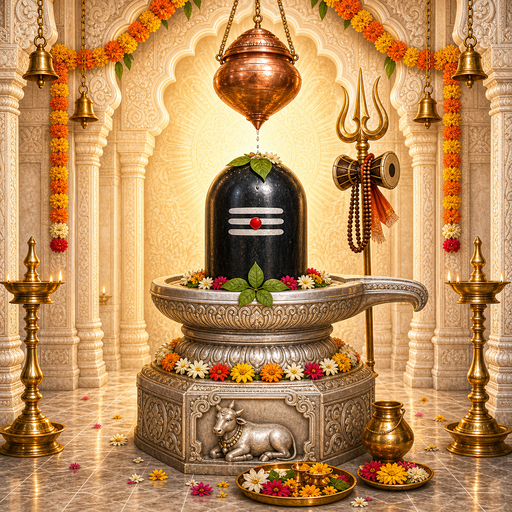
This year's dates (2026)
Deity and significance
The deity is Lord Shiv — worshipped as Ramanathaswamy ("Lord of Ram," i.e., Ram's Shiv) in the form of a Jyotirlinga; the consort deity is Parvathavardhini (Parvati). In the traditional hymn order of the twelve Jyotirlingas, Rameshwar is seventh, following Somnath, Mallikarjuna, Mahakaleshwar, Omkareshwar, Vaidyanath, and Bhimashankar — the hymn line "Setubandhe tu Ramesham Nagesham Darukavane" uses "Setubandha" as Rameshwar's older name.
Among the four Dhams traditionally associated with Adi Shankaracharya's four cardinal directions, Rameshwaram is the southern one — alongside Badrinath (north), Jagannath Puri (east), and Dwarka (west). Tradition holds that the pilgrimage should begin at Puri and proceed clockwise.
Since the legend has Ram (an avatar of Vishnu) worshipping Shiv here, the site is revered by both Shaiva and Vaishnava devotees — regarded as a symbol where the two traditions meet. The temple is also one of the 276 Padal Petra Sthalams, praised by the 7th-8th century Shaiva saints Appar, Sundarar, and Tirujnanasambandar.
History and legend
After slaying Ravana, Ram — on the advice of sages, to atone for the sin of killing a Brahmin (Ravana being considered Brahmin by lineage) — decided to install and worship a Shivling on the shore at Rameshwaram. He sent Hanuman to fetch a linga from Kailash; when the auspicious moment arrived and Hanuman hadn't returned, Sita shaped a linga out of sand (Ramalingam), and the worship was completed in time. Hanuman later arrived with his linga (Vishwalingam); in honour of Hanuman's effort, Ram established the practice of worshipping Vishwalingam first — a tradition still followed today.
This sand-linga story isn't mentioned directly in the original Valmiki Ramayana, nor in the Tamil Kamba Ramayanam (12th-13th century) — it appears in later versions (the Adhyatma Ramayana, Shiv Purana, Linga Purana, Skanda Purana, Padma Purana, and Tulsidas's Ramcharitmanas). This is a popular, centuries-old tradition.
Nala, of the monkey army (regarded as the son of Vishwakarma), was the chief architect of the bridge's construction; his brother Nila also contributed. With the help of the monkey army, a bridge roughly ten yojanas long is believed to have been completed in just five days.
The temple's construction history spans several periods. In the 12th century, one source credits the Pandya dynasty with expanding the temple, while another credits the Setupati Maravar rulers — since the two accounts differ on the dynasty, no single credit is given here. Between 1380 and 1410, the Jaffna (Sri Lanka) king Jayavira Cinkaiariyan renovated the sanctum using stone brought from the Koneswaram temple at Trincomalee. In the 17th century, Setupati king Kilavan Setupati is believed to have sanctioned the temple's present main form. Between 1763 and 1795, Muthuramalinga Setupati built the temple's famous third corridor (the "Chokkattan Mandapam").
Between 1745 and 1837, Maratha kings of Thanjavur — Pratapsingh (r. 1739-1763) and Serfoji II (r. 1798-1832) — built and expanded numerous chatrams (rest-houses) along the Rameshwaram pilgrimage route and endowed the temple. This was the tradition of providing food and lodging for pilgrims travelling between Kashi and Rameshwaram. Serfoji II was renowned as a scholarly king and patron of arts, education, and medicine — this is a direct thread of Maratha heritage outside Maharashtra.
In 1897, returning to India after his Chicago address, Swami Vivekananda arrived at Rameshwaram by boat from Sri Lanka on 26 January; Raja Bhaskara Setupati of Ramnad gave him a grand welcome. A memorial near Pamban commemorates this visit.
One source records an invasion by Malik Kafur, a general of the Delhi Sultanate, in the early 14th century — this detail hasn't been independently corroborated.
Architecture and layout
The temple covers roughly 15 acres; it stands on Pamban Island (regarded as shaped like Vishnu's conch), near Agni Theertham (the sea-shore bathing spot).
This is regarded as India's longest temple corridor — the outer corridor runs roughly 3,850 feet in total, with about 1,212 carved pillars, standing roughly 30 feet tall. The third (and most famous) corridor measures 197 metres east-west and 133 metres north-south — some official sources call this "the longest in Asia," while a district portal calls it "the third-longest in the world." The exact title and measurement vary by source, but the underlying fact — that this is India's longest temple corridor — is solid.
Sources directly conflict on the height of the main gopuram — one gives 53 metres, another 38 metres — both figures are recorded here, with neither selected as definitive.
The sanctum holds the main Ramanathaswamy linga; there's a separate shrine to Goddess Parvathavardhini, a shrine to Goddess Vishalakshi, a shrine to sage Patanjali, and shrines to Vinayaka and Subrahmanya — along with several mandapams (Anuppu, Sukravara, Setupati, Kalyana, Nandi). The Nandi idol stands about 17.5 feet tall.
Main festivals and pilgrimage
| Festival | Date (2026) | Connection |
|---|---|---|
| Mahashivratri | 15 February | The Ramanathaswamy temple too observes this over several days (some sources say around 10), with chariot processions |
The temple's other annual festivals follow the Tamil solar calendar, which doesn't map directly onto this site's Marathi amanta panchang — so exact 2026 dates aren't given here, only general timeframes:
- Vasanthotsavam — roughly May-June, about 10 days — welcoming spring, with sandalwood abhishek.
- Aani Thirumanjanam/Thirukalyanam — roughly July-August, about 17 days (one of the temple's longest festivals) — the deity's divine wedding celebration, with sources estimating 2-3 lakh devotees.
- Arudra Darshanam — roughly December-January, about 10 days.
- Navratri — generally observed.
The exact dates of all these festivals change every year according to the Tamil panchang — confirm with the temple committee before an actual visit.
Darshan and aarti timings
According to the official HR&CE website, the general schedule runs: 4 AM to 1 PM, and 3 to 8 PM. Darshan of the sanctum itself begins from about 6:10 AM. Spatika Linga puja takes place from 5 to 6 AM, during which devotees can watch an abhishek with Ganga water performed on the crystal linga. Theertham (holy bath) timing runs 5:30 AM to 12:30 PM, and 3 to 7 PM.
Some other sources give slightly different timings (5 AM to 1 PM, 3 to 9 PM) — confirm which is currently accurate before an actual visit. The temple is reported closed between 1 and 3 PM by most sources — plan your visit accordingly.
Online facilities available through the official website include e-donation registration, QR-code donations, and temple live-streaming. Exact fees for special/fast-track darshan tickets are reported differently across sources — confirm before an actual visit.
Rituals here
Tradition holds that pilgrims bathe in sequence at 22 sacred wells before entering the sanctum — regarded as a symbol of atonement and self-purification. Agni Theertham (the sea-shore) is the first and most important. The number "22" is regarded as symbolising the 22 arrows in Ram's quiver. Representative names are given here (Mahalakshmi Theertham, Savitri Theertham, Gayatri Theertham, Brahmahatti Vimochana Theertham, Ganga Theertham, Yamuna Theertham, and others), not the complete official list.
In memory of the honour Ram gave Hanuman's effort, tradition holds that Vishwalingam is worshipped before Ramalingam in the puja sequence.
Some sources describe a dress code as follows — for men, a dhoti or pyjama-shirt is recommended (lungis, Bermuda shorts, jeans, and tight leggings aren't allowed); for women, a saree, chudidar, or pavadai is recommended (jeans/T-shirts aren't allowed); footwear must be removed before entry. These rules aren't clearly stated in any official source, so confirm before an actual visit.
Most sources say mobile phones, cameras, and photography are strictly barred inside the temple premises — a cloakroom is available near the east gate, though sources disagree on the fee.
How to reach
Rameshwaram railway station is in the town itself, about 1-1.3 km from the temple — with direct trains from Chennai and Madurai. The new Pamban Bridge (inaugurated April 2025, India's first vertical-lift sea railway bridge) replaces the 1914 British-era cantilever bridge — the rail line now runs over it.
The nearest airport is Madurai — roughly 150-180 km away (the figure varies slightly by source), followed by about 3-4 hours by road. The Ramanathapuram-Rameshwaram National Highway (NH87) connects to the mainland.
For Marathi devotees travelling from Mumbai, Pune, or Nashik, direct rail connectivity to Rameshwaram is limited — practical routes are flying to Madurai (via connecting flights) and continuing by road for 3-4 hours, or taking a train first to Madurai or Chennai and continuing locally to Rameshwaram. Train numbers and schedules can change, so verify before travelling.
Nearby places
- Dhanushkodi — about 18-20 km away; a ghost town devastated in the catastrophic 1964 cyclone. Only the Kothandaramaswamy Temple (dedicated to Ram, on the seashore) survived and remains active today. It's the south-eastern tip of Pamban Island, facing the Adam's Bridge chain toward Sri Lanka.
- Pamban Bridge — the old one (1914, cantilever) and the new one (2025, vertical-lift railway bridge) — both connect Rameshwaram island to the mainland.
- Adam's Bridge (Ram Setu) — a roughly 29 km chain of limestone shoals between Rameshwaram and Sri Lanka's Mannar Island; traditionally linked to Ram's bridge-building.
- Panchmukhi Hanuman Temple — about 0.5 km from the main temple's western entrance.
- Dr. APJ Abdul Kalam Memorial — the birthplace and memorial of the former President.
- Vivekananda Memorial — on Kunthukal beach near Pamban.
- Gulf of Mannar Marine National Park.
Traveller tips
- The temple is closed between 1 and 3 PM — plan your visit accordingly.
- Carry quick-drying clothes for the 22 theertham baths.
- Most travel sources report that mobiles and cameras aren't allowed inside the temple premises — confirm the current rule with the temple committee/HR&CE and use the cloakroom near the east gate.
- Check the dress code in advance and dress appropriately.
- October to March is generally the best time to visit — summers bring harsh heat.
- The Kashi-Rameshwaram combined pilgrimage is a widespread tradition — devotees following it bring Ganga water from Varanasi or Prayagraj to perform abhishek here, and carry Rameshwaram's sand back north to immerse in the Ganga. The practice varies by family and sampradaya — it isn't a requirement for everyone.
Good to know
- Rameshwaram is a rare site on both the twelve-Jyotirlinga and Char Dham lists — keep both significances in mind when planning a visit.
- The sand-linga story comes from later Puranic versions, not the original Valmiki Ramayana — it remains a centuries-old, respected tradition regardless.
- Local "Rameshwar/Ramanath" fairs at Humarmala (Maharashtra) and Majali-Karwar (Karnataka) are unrelated to this Jyotirlinga in Tamil Nadu — don't confuse them.
FAQ
- Which state is Rameshwaram in, and who is the deity?
- In Ramanathapuram district, Tamil Nadu, on Pamban Island; the deity is Shiv (as Ramanathaswamy).
- Which of the twelve Jyotirlingas is Rameshwaram?
- Seventh in the traditional hymn order — the southernmost Jyotirlinga.
- What are the 22 wells at the Rameshwaram temple for?
- Tradition holds that pilgrims bathe in sequence at them before entering the sanctum — regarded as a symbol of atonement and self-purification; Agni Theertham (the sea-shore) is the first and most important.
- How long is the Rameshwaram temple's longest-in-India corridor?
- The outer corridor runs roughly 3,850 feet in total, on about 1,212 pillars — regarded as the longest temple corridor in India.
- Where does Ram Setu (Adam's Bridge) begin from Rameshwaram?
- A roughly 29 km chain of limestone shoals between Rameshwaram and Sri Lanka's Mannar Island — traditionally linked to Ram's bridge-building.
- Why is Rameshwaram part of the Char Dham pilgrimage?
- It's the southern Dham among the four cardinal directions traditionally associated with Adi Shankaracharya — alongside Badrinath, Jagannath Puri, and Dwarka.
- How do I reach Rameshwaram from Mumbai or Pune?
- Direct rail connectivity is limited — fly to Madurai and continue by road, or take a train first to Madurai/Chennai and continue locally.
- What is Dhanushkodi, and how far is it from Rameshwaram?
- A town about 18-20 km from Rameshwaram, devastated in the 1964 cyclone — only the Kothandaramaswamy Temple survived.
- What is the connection between the Kashi and Rameshwaram pilgrimages?
- A widespread pilgrimage tradition has devotees bring Ganga water from Varanasi/Prayagraj to perform abhishek on the Ramanathaswamy linga, and carry Rameshwaram's sand north to immerse in the Ganga — the practice varies by family and sampradaya rather than being a fixed rule for everyone.
- Which kings built the Rameshwaram temple?
- Across several periods — the Pandya/Setupati kings in the 12th century, Jaffna kings in the 14th century, Setupati kings in the 17th-18th centuries, and Maratha kings of Thanjavur, all contributed.
Related Info
 Maha Shivratri15 Feb
 Ram Navami26 Mar
 Trimbakeshwar14 Jan
 Bhimashankar15 Feb
 Grishneshwar15 Feb
 Aundha Nagnath15 Feb
 Parli Vaijnath13 Feb
 Deoghar Baidyanath Dham15 Feb
- Dwarka Nageshwar15 Feb
- Mallikarjuna Jyotirlinga (Srisailam)15 Feb
- Mahakaleshwar (Ujjain, Madhya Pradesh)15 Feb
- Kedarnath15 Feb
- Kashi Vishwanath (Varanasi, Uttar Pradesh)15 Feb
- Omkareshwar (Madhya Pradesh)25 Jan
- Somnath15 Feb