Navagraha
Navagraha refers to the nine "grahas" of Jyotisha (Hindu astrology) — Surya, Chandra, Mangal, Budh, Guru (Brihaspati), Shukra, Shani, Rahu, and Ketu. Rahu and Ketu aren't physical planets — they are two points on the Moon's orbit (lunar nodes) — yet tradition treats them as graha-devatas. One important mix-up is cleared up here — the popular weekday vrat observed in Maharashtra on days like Monday or Tuesday is usually devoted to a completely different deity (Shiv, Hanuman...) than that weekday's own Navagraha planetary deity; this distinction is explained in its own section below.
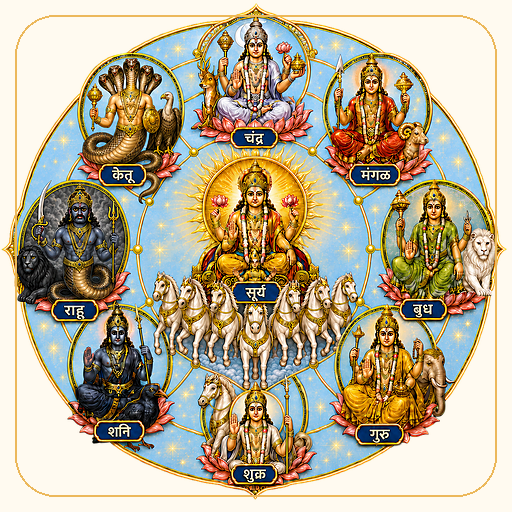
Navagraha is a belief-based system within Jyotisha — not a part of modern astrophysics; this page presents it consistently from that standpoint.
Two of these nine (Surya and Shani) already have their own detailed festival/temple pages on this site — this page doesn't repeat that content. The remaining seven (Chandra, Mangal, Budh, Guru, Shukra, Rahu, Ketu) have no dedicated planetary-deity page anywhere else on the site, so they get a fuller introduction here.
Significance
Navagraha forms the foundational framework of Jyotisha — considered one of the six Vedangas — where each graha is regarded as presiding over specific zodiac signs, life domains, and dasha periods.
Historically, the Vedic period (Rigveda/Atharvaveda) had no organised nine-graha model. Contact with Hellenistic and Babylonian astronomy in the early centuries CE reshaped Indian planetary thought; the seven-day week was adopted after the 3rd century CE. The Yavanajataka (around 120-150 CE) is credited with standardising Indian horoscopic astrology through this Greco-Babylonian synthesis; Rahu and Ketu are believed to have become established as full "chaya grahas" (shadow planets) by around the 8th-9th century.
Guru, Shukra, Budh, and a waxing Chandra are generally considered "benefic grahas"; Mangal, Shani, Rahu, Ketu, and (under some conditions) Surya are considered "malefic/krura grahas." This is an astrological classification, not a moral judgment of any graha.
Most Hindu temples have a "Navagraha mandapa" — Surya at the centre, the other eight grahas placed in eight directions around him. This is a general pan-Indian observation, not a claim specific to Maharashtra.
The nine grahas, in order
For the two grahas that already have their own detailed page (Surya, Shani), only a brief introduction and a link are given here — the remaining seven get a fuller introduction.
1. Surya
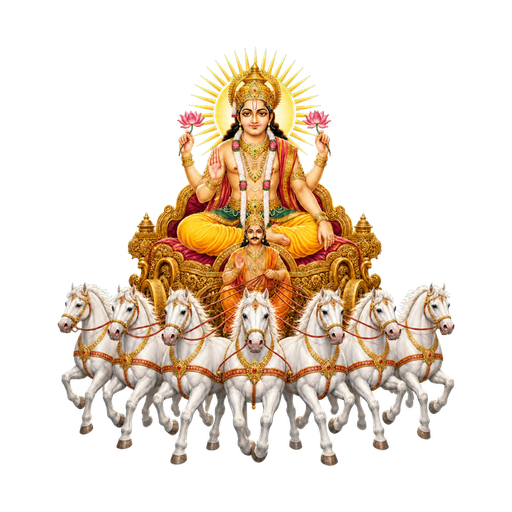
The king of the grahas — considered the son of Aditi and sage Kashyap; the significator of leadership, the soul, and life force. Sunday is his day, and he rules the Leo (Simha) sign. The full birth legend, puja vidhi, and both Surya festivals already exist on the Ratha Saptami and Bhanu Saptami pages.
2. Chandra (the Moon)
The second graha in Navagraha — considered the significator of the mind, emotions, and fertility. Monday (named after Som/Chandra) is his day, ruling the Cancer (Karka) sign, with white as his colour. In legend, he is considered the son of sage Atri and Anasuya; some versions describe him as an avatar of Brahma. A well-known story tells of sage Daksha cursing him with a wasting affliction out of anger at his excessive love for Rohini, one of his 27 nakshatra-wives — later softened into what is believed to explain the waxing and waning of the moon's phases. His vehicle is a chariot drawn by antelopes.
Somvar Vrat is mainly a Shiv-devotional vrat, not a dedicated worship of the Chandra graha — this distinction between the weekday deity (Shiv) in the panchang and the graha-devata (Chandra) in Navagraha is explained in its own section below.
3. Mangal (Mars)
The third graha in Navagraha, regarded as the "commander graha." Tuesday (named after him) is his day, ruling the Aries (Mesh) and Scorpio (Vrishchik) signs, with red as his colour. Two versions of his birth legend are told, recorded here with equal standing — in Vaishnava tradition, he is the son of Bhudevi (the earth goddess) and Vishnu's Varaha avatar (born when Varaha lifted the earth from the netherworld); in Shaiva tradition, he is born from drops of Shiv's sweat during his grief over Sati. Both share the epithet "son of the earth." In form, he is red-complexioned, a four-armed warrior, and rides a ram.
In astrology, Mangal Dosha is a well-known concept — when Mangal sits inauspiciously in a specific house of the birth chart, it is factored into marriage matchmaking. This is an astrological belief, not a scientific criterion.
Mangalvar Vrat (Hanuman) is mainly a Hanuman/Devi-devotional vrat, not a dedicated worship of the Mangal graha.
4. Budh (Mercury)
The fourth graha in Navagraha, the significator of intellect and memory. Wednesday (named after him) is his day, ruling the Gemini (Mithun) and Virgo (Kanya) signs, with green as his colour. In legend, he is considered the son of Chandra and Tara (Brihaspati's wife). His vehicle is a chariot drawn by eight yellow horses.
The Budh Pradosh vrat, popular on Wednesdays, is mainly a Shiv-devotional observance — Budh is mentioned there only as the origin of the weekday's name, not as a dedicated graha worship.
5. Guru / Brihaspati (Jupiter)
The fifth graha in Navagraha, the guru (teacher) of the devas and the significator of the expansion of knowledge. Thursday (named after him) is his day, ruling the Sagittarius (Dhanu) and Pisces (Meen) signs, with yellow/golden as his colour. The Rigveda describes him as "born from the first great radiance, dispelling darkness"; he is considered the son of sage Angiras and Surupa. His vehicle is a chariot drawn by eight white horses.
The astrological use of the Guru graha (Guru Ast and its muhurat rules) is already covered separately on the Guru Ast panchang-concept page. Guruvar Vrat (Datta) is mainly a Dattatreya-devotional vrat, not a dedicated worship of the Guru graha.
6. Shukra (Venus)
The sixth graha in Navagraha, the significator of beauty, prosperity, and marital happiness. Friday (named after him) is his day, ruling the Taurus (Vrishabh) and Libra (Tula) signs, with white/silver as his colour. In legend, he is the son of sage Bhrigu and Kavyamata, known as "Shukracharya," the guru of the asuras/daityas — famous especially for the Sanjeevani Vidya, the knowledge of reviving the dead. His vehicle is a camel.
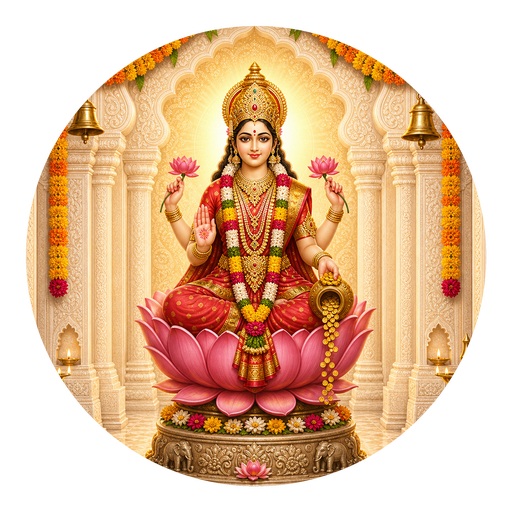
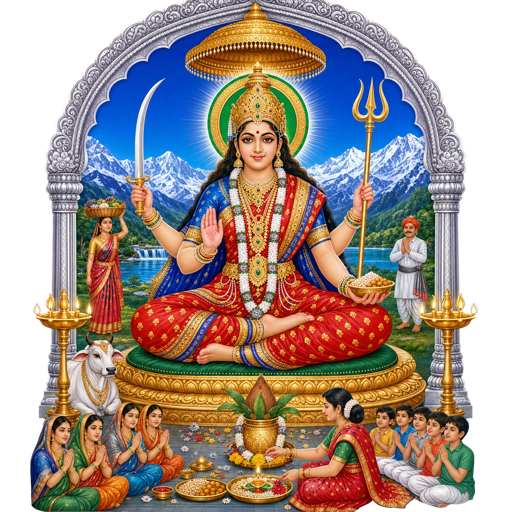
The astrological use of the Shukra graha (Shukra Ast and marriage-muhurat rules) is already covered separately on the Shukra Ast panchang-concept page. The Vaibhav Lakshmi Vrat and Santoshi Mata Vrat, both popular on Fridays, are mainly Lakshmi/Devi-devotional vrats, not a dedicated worship of the Shukra graha.
7. Shani (Saturn)
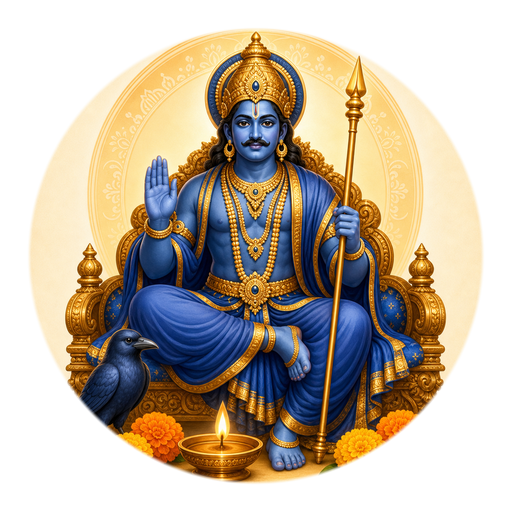
The seventh graha in Navagraha — considered the son of Surya and Chhaya, regarded as the deity of karmic justice. Saturday is his day, ruling the Capricorn (Makar) and Aquarius (Kumbh) signs, with black/blue as his colour. The full birth legend, Sade Sati, and places of worship already exist in detail on the Shani Jayanti, Shani Amavasya, Shani Shingnapur, and Shanivar Vrat pages.
8. Rahu
Rahu is not a physical planet — he is one intersection point (a lunar node) of the Moon's orbit and the ecliptic. This graha has no weekday of his own; his gemstone is hessonite (gomed). Rahu's mythological origin story and the complete calculation method for Rahukaal (the daily inauspicious window) are already covered in detail on the Rahu Kaal page; the clear astronomy-versus-mythology split for Rahu and Ketu is given in its own section below.
9. Ketu
Ketu, too, is not a physical planet — he is the other intersection point (lunar node) of the Moon's orbit. Like Rahu, Ketu has no weekday of his own; his gemstone is cat's eye (lehsunia). In astrology, Ketu is considered the significator of moksha, renunciation, self-realisation, and detachment — believed to cause material loss while also turning a person toward spirituality. Ketu doesn't appear separately on the Rahu Kaal page, so his own form is introduced here.
Navagraha weekday-colour-gemstone table
Colour entries come from two different traditions — deity/graha-hue-based colours, and gemstone-based (Navaratna) colours. Both are shown in the same table; neither should be taken as the "true" colour — it varies by tradition.
| Graha | Weekday | Zodiac rulership | Colour (deity-hue) | Gemstone (Navaratna) |
|---|---|---|---|---|
| Surya | Sunday | Leo | Saffron | Ruby |
| Chandra | Monday | Cancer | White | Pearl |
| Mangal | Tuesday | Aries, Scorpio | Red | Red coral |
| Budh | Wednesday | Gemini, Virgo | Green | Emerald |
| Guru | Thursday | Sagittarius, Pisces | Yellow/golden | Yellow sapphire |
| Shukra | Friday | Taurus, Libra | White/silver | Diamond |
| Shani | Saturday | Capricorn, Aquarius | Black/blue | Blue sapphire |
| Rahu | (no weekday of his own) | Aquarius (co-ruler with Shani) | Grey/dark | Hessonite garnet |
| Ketu | (no weekday of his own) | — | Smoky grey | Cat's eye |
Rahu-Ketu: astronomy vs. mythology
This is a frequently confused point — so the astronomical and mythological accounts are kept as two separate, both-valid explanations here:
The astronomical fact (a scientific statement): Rahu and Ketu are not physical celestial bodies. They are two points where the Moon's orbit around Earth and Earth's orbit around the Sun (the ecliptic) intersect — Rahu is the ascending (north) point, Ketu the descending (south) point. When the Sun or Moon comes near either point, an eclipse occurs. These points complete one cycle roughly every 18.6 years.
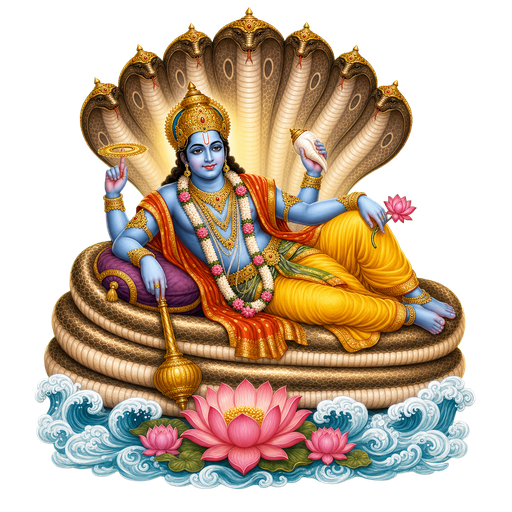
The mythological account (belief/tradition): While distributing the amrita (nectar) churned from the ocean of milk, Vishnu took the form of Mohini — see the Dashavatar page for this and Vishnu's other avatar-forms. The demon Swarbhanu disguised himself among the devas and drank the nectar; when the Sun and Moon recognised and revealed him, Vishnu severed his head from his body with the Sudarshan Chakra. Because the nectar had already touched him, he did not die — the head became Rahu, the torso became Ketu — and Rahu is since considered an enemy of the Sun and Moon (the traditional explanation for eclipses).
Both statements are treated as valid on this page — neither is presented as disproving the other, since they belong to two different frames of knowledge (science vs. mythology); they shouldn't be blended together. Rahukaal (the daily inauspicious window) and its full calculation method are already covered on the Rahu Kaal page — this page doesn't teach that calculation.
Weekday deity vs. graha deity — a common mix-up
The popular weekday-based worship practised across Maharashtra is usually devoted to a different deity than that weekday's own graha-devata in the Navagraha system — only on Saturday do the weekday deity and the graha deity coincide:
| Weekday | Navagraha graha-devata | Popular Maharashtra weekday-vrat deity | Example page |
|---|---|---|---|
| Monday | Chandra | Shiv | Somvar Vrat |
| Tuesday | Mangal | Hanuman/Devi | Mangalvar Vrat (Hanuman) |
| Wednesday | Budh | Shiv (Budh Pradosh) | Budh Pradosh |
| Thursday | Guru (Brihaspati) | Dattatreya | Guruvar Vrat (Datta) |
| Friday | Shukra | Lakshmi/Devi | Vaibhav Lakshmi Vrat |
| Saturday | Shani | Shani (the only day both match) | Shanivar Vrat |
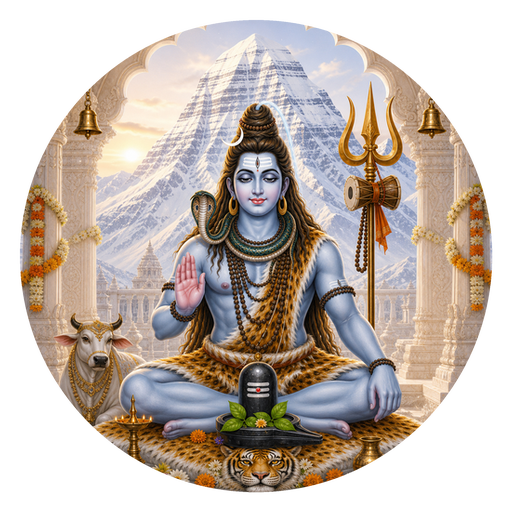
All seven weekday Pradosh pages — Ravi Pradosh, Soma Pradosh, Bhaum Pradosh, Budh Pradosh, Guru Pradosh, Shukra Pradosh, and Shani Pradosh — are further examples of this same pattern: their core is Shiv worship tied to the Trayodashi tithi falling on a given weekday; the graha of that weekday is mentioned only as the origin of its name, not as a dedicated graha puja.
Who observes it
Generally, all devotees — when a graha's placement in the birth chart is believed to be unfavourable, a widespread astrological practice calls for specific worship, charity, or mantra japa for that graha's pacification.
Before auspicious undertakings — a wedding, a housewarming, a new venture — a collective Navagraha Shanti puja is performed. This is usually part of a priest-led homa/puja ritual, not a household single-person vrat; only its general form and purpose are given here, not a complete step-by-step procedure.
Surya (Ratha Saptami/Bhanu Saptami) and Shani (Shanivar Vrat/Shani Jayanti/Shingnapur) already have their own devotee base and customs detailed on their own pages.
Which graha is considered "most important or powerful" varies by sampradaya and family tradition — this shouldn't be taken as a universal ranking.
Mantra & stotra
The Navagraha Stotra — traditionally credited to Maharshi Vyasa — carries nine separate beej-mantras, one for each graha; each is traditionally paired with a short meaning or concept (for example, light of knowledge for Surya, the cool light of devotion for Chandra).
Individual graha mantras (such as "Om Suryaya Namah") are widely described as simple japa-mantras built on beej syllables. Detailed avatar/graha-specific mantras and stotras (such as the Shani mantra), where they already exist on their own page, stay there.
Regional customs
In Maharashtra, for the pacification of Rahu-Ketu-related doshas — Kaal Sarp Shanti, Narayan Nagbali — Trimbakeshwar (near Nashik) is regarded as the leading site in Maharashtra, and by many accounts in India. This is already covered in full, with appropriate caveats, on the Trimbakeshwar page.
No Navagraha-specific, Maharashtra-only custom was found in this research for Chandra, Budh, Guru, or Shukra — this is honestly recorded rather than invented. The concept of Mangal Dosha is pan-Indian, not specific to Maharashtra.
This year's dates
This page isn't tied to any single date — Navagraha isn't a tithi-based concept. Only two of the nine grahas (Surya, Shani) already have their own dated festival pages on this site:
| Graha | Festival | 2026 date | Page |
|---|---|---|---|
| Surya | Ratha Saptami | 25 January | Ratha Saptami |
| Surya | Bhanu Saptami | (Sunday + Saptami combination, several times a year) | Bhanu Saptami |
| Shani | Shani Jayanti | 16 May | Shani Jayanti |
| Shani | Shani Amavasya | (Amavasya + Saturday combination) | Shani Amavasya |
No date is assumed on this page for any dedicated festival of Chandra, Mangal, Budh, Guru, Shukra, Rahu, or Ketu.
Good to know
- If the popular weekday vrat on Monday, Tuesday, Wednesday, Thursday, or Friday doesn't seem to match that weekday's own Navagraha graha-devata, there's no need for concern — both forms of worship are separate, equally genuine traditions.
- Remembering that astronomy (lunar nodes) and mythology (Swarbhanu) are two different statements about Rahu-Ketu helps avoid confusion when reading about them.
- Colour and gemstone lists vary by source — before wearing any gemstone, it's worth having a knowledgeable person confirm it actually suits your own birth chart.
FAQ
- What is Navagraha?
- The nine "grahas" of Jyotisha — Surya, Chandra, Mangal, Budh, Guru, Shukra, Shani, Rahu, and Ketu — believed to influence human life.
- What are the Navagraha, and in what order?
- Surya, Chandra, Mangal, Budh, Guru (Brihaspati), Shukra, Shani, Rahu, Ketu — this is the standard, widely accepted order.
- Are Rahu and Ketu real planets?
- No — they are two points on the Moon's orbit (lunar nodes), not physical celestial bodies; tradition nonetheless treats them as graha-devatas within Navagraha.
- What do Rahu and Ketu mean — what is their origin story?
- During the churning of the ocean, Vishnu in his Mohini form beheaded the demon Swarbhanu — the head became Rahu, the torso became Ketu. The full legend and the Rahukaal time calculation are on the Rahu Kaal page.
- What weekday and colour belongs to each graha?
- See the "Navagraha weekday-colour-gemstone table" above — colours and gemstones vary slightly by source, and that variation is noted clearly.
- Why is a Navagraha Shanti puja performed?
- It's a collective puja performed before auspicious undertakings, to gain the grahas' favour and reduce unfavourable planetary influence — it's usually a priest-led ritual.
- What is Mangal Dosha?
- An astrological dosha considered present when Mangal sits inauspiciously in a specific house of the birth chart, factored into marriage matchmaking — it's a belief, not a scientific criterion.
- What is Shani's Sade Sati?
- A period of roughly seven and a half years tied to Shani's transit in the birth chart — the full detail is on the Shanivar Vrat and Shani Jayanti pages.
- Which of the Navagraha are considered benefic and which malefic?
- Guru, Shukra, Budh, and a waxing Chandra are generally "benefic"; Mangal, Shani, Rahu, Ketu, and, under some conditions, Surya are considered "malefic" — this is an astrological classification.
Related Info
 Ratha Saptami (Surya Jayanti)25 Jan
- Bhanu Saptami25 Jan
 Shani Jayanti16 May
- Shani Amavasya16 May
- Shani Shingnapur9 Mar
- Shanivar Vrat
- Ravi Pradosh1 Mar
 Soma Pradosh16 Mar
 Bhaum Pradosh25 Aug
- Budh Pradosh15 Apr
- Guru Pradosh14 May
 Shukra Pradosh16 Jan
- Shani Pradosh14 Feb
 Trimbakeshwar14 Jan
- Somvar Vrat / Solah Somvar Vrat17 Aug
- Mangalvar Vrat (Hanuman)
 Guruvar Vrat (Datta)
 Vaibhav Lakshmi Vrat
 Santoshi Mata Vrat
 Vishnu Dashavatar